
Why Natural Pink Diamonds Are So Rare
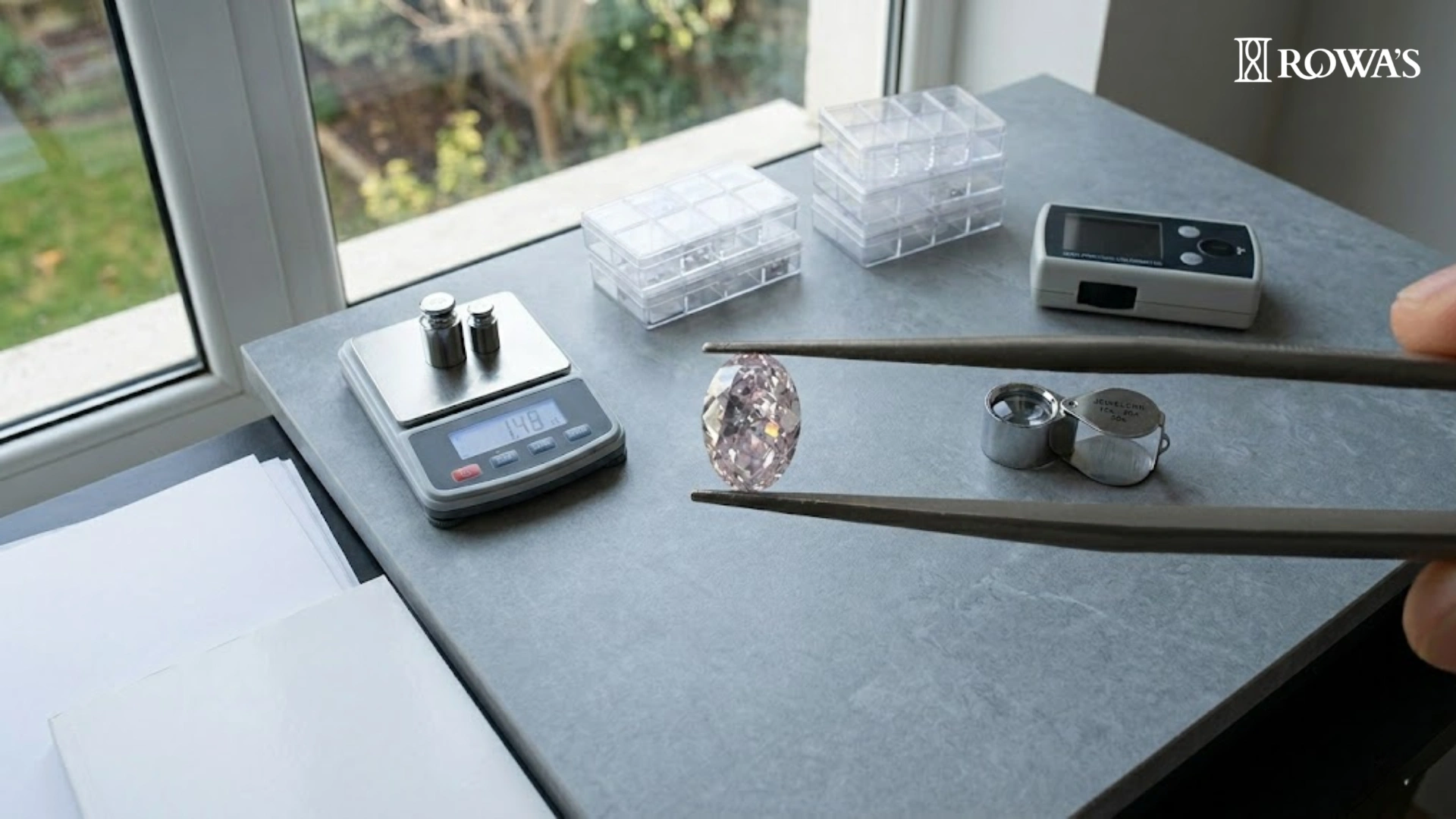
Of all the diamonds ever discovered on Earth, less than 0.1% are pink. And of those, most are so tiny they’d barely cover your pinky nail. Yet these delicate, rose-hued stones command prices that make even the finest white diamonds look affordable. Why? Let’s break it all down in plain English.
What Makes a Diamond Pink in the First Place?
Here’s something that will genuinely surprise you: scientists still don’t fully agree on why pink diamonds are pink.
With most colored diamonds, the science is straightforward. Yellow diamonds get their color from nitrogen. Blue diamonds contain boron. Green diamonds were exposed to natural radiation underground.
But pink diamonds? They contain none of those things. They’re chemically pure carbon identical to a colorless white diamond. So where does that blush come from?
The leading theory is something called plastic deformation. As the diamond was pushed toward the surface through volcanic pipes, it experienced enormous shock, intense heat, pressure, and seismic force. This distorted the diamond’s crystal structure at a microscopic level, changing how it absorbs light. The result? Pink.
It’s less like adding a color and more like bending the stone until it blushes. That had to happen in a very specific way, at a very specific depth, under very specific conditions. Which is exactly why it almost never happens.
The Argyle Mine – And Why Its Closure Changed Everything
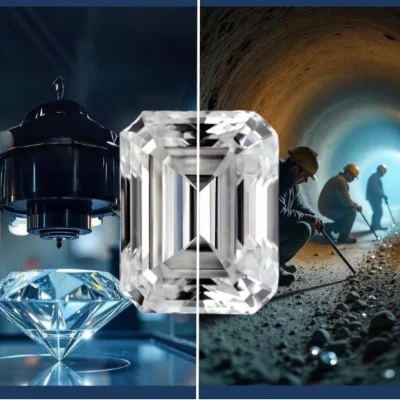
For nearly four decades, one single mine in remote Western Australia was responsible for over 90% of the world’s pink diamond supply. That was the Argyle Diamond Mine, operated by Rio Tinto.
Even at its peak, the yield was staggering in its scarcity. For every one million carats of rough diamonds mined, only about one carat qualified as a true pink diamond. The mine closed permanently in November 2020 and with it, the world lost its most reliable source of pink diamonds forever.
Since then, prices on the secondary market have surged. Every certified Argyle pink diamond became a piece of finite, irreplaceable history overnight. Other sources exist Brazil, Russia, South Africa but none come close to what Argyle produced. The global supply is now simply shrinking, year by year.
Rarity Is Layered – It’s Not Just One Thing
Most people think of pink diamond rarity as a single fact. It’s actually a stack of rare conditions, each one multiplying the last.
Geological rarity – The structural trauma needed to create pink color almost never occurs during diamond formation. Nature rarely delivers it.
Geographic rarity – Only a handful of places on Earth have ever produced them, and the biggest source is gone forever.
Size rarity – Most pink diamonds are under 1 carat. Anything above 5 carats is a once-in-a-decade discovery. Above 10 carats is front-page news in the gem world.
Color intensity rarity – Even among pink diamonds, truly vivid stones are a tiny fraction. The vast majority are faint or light pink. Fancy Vivid Pink the top grade represents only a fraction of a fraction of total production.
Each layer compounds the value. It’s not one thing making them expensive. It’s everything, all at once.
How Pink Diamonds Are Graded
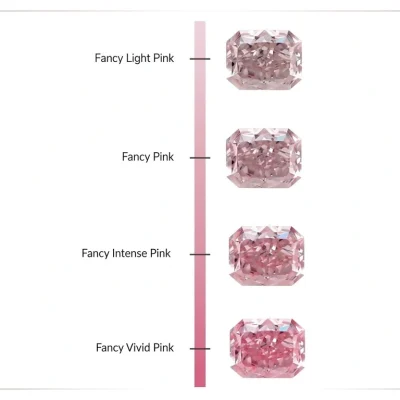
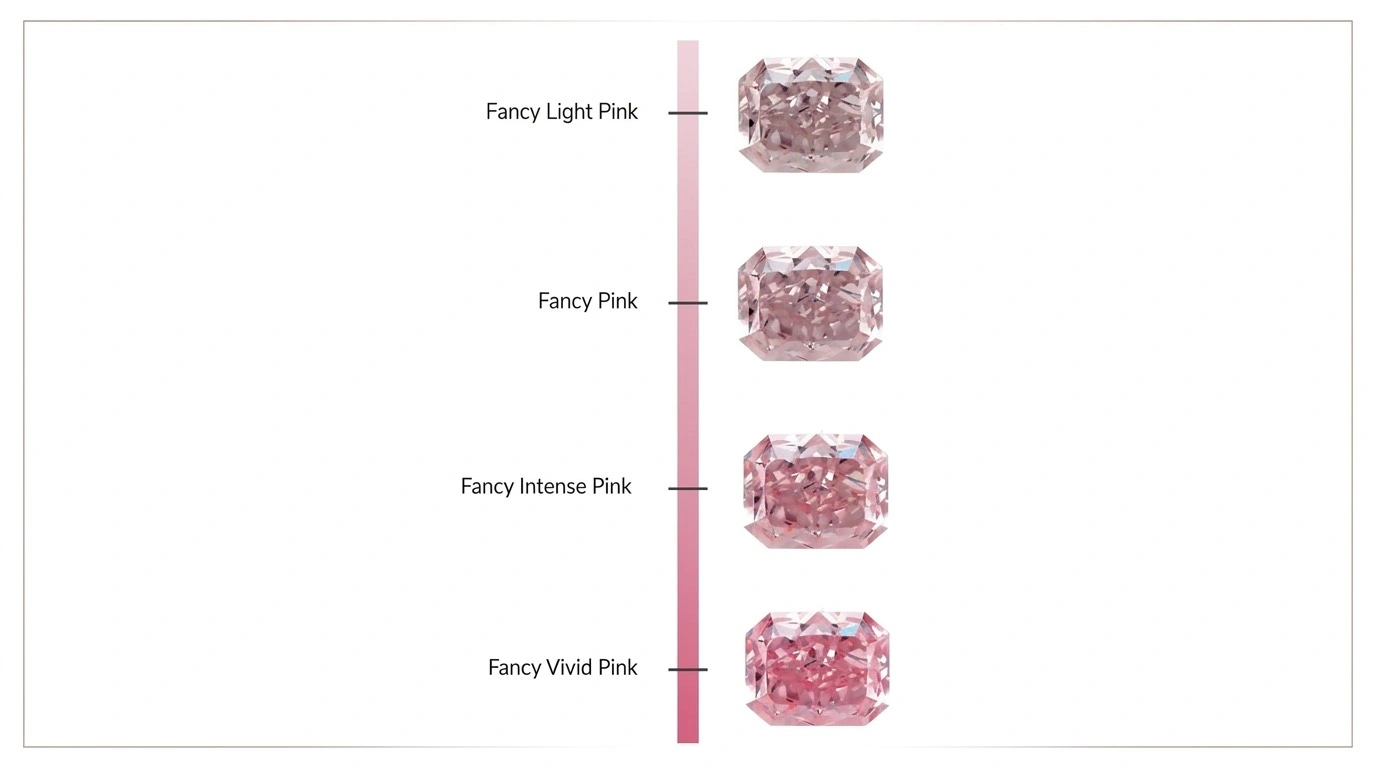
The GIA (Gemological Institute of America) grades pink diamonds on a color intensity scale that has an enormous impact on value often more than carat size.
- Faint Pink – barely visible hint of color
- Very Light Pink – subtle, still understated
- Light Pink – noticeably pink, growing desirability
- Fancy Light Pink – where serious collector interest begins
- Fancy Pink – beautiful, significant value jump
- Fancy Intense Pink – rare, commands strong premiums
- Fancy Vivid Pink – the rarest, most valuable, the stuff of auction records
A Fancy Vivid Pink can sell for 20 to 50 times more per carat than a Fancy Light Pink of the same size. The color grade alone is that powerful.
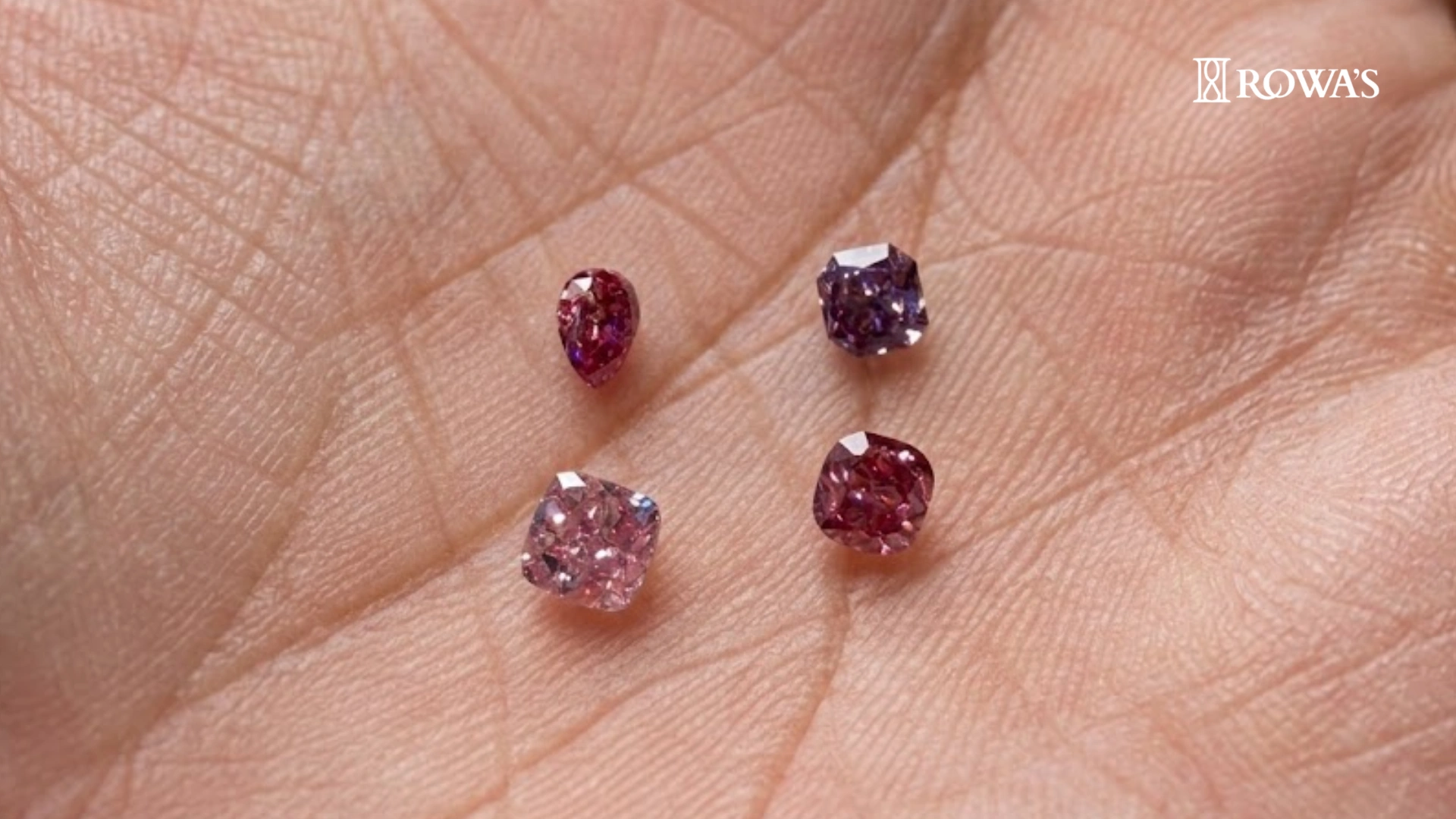
Secondary hues matter too. A pure pink with no brownish or purplish modifier is rarer and worth more. Argyle was uniquely prized for producing stones with exceptionally pure, saturated pink which is a big reason why Argyle-certified diamonds still carry a premium on the market today.
Famous Pink Diamonds That Made History
Nothing tells this story better than auction records and pink diamonds break them with remarkable consistency.
The Pink Star – 59.60 carats, Fancy Vivid Pink, internally flawless. Sold at Sotheby’s Hong Kong in 2017 for $71.2 million. At the time, the highest price ever paid for any diamond or gemstone at auction.
The Williamson Pink Star – 11.15 carats, Fancy Vivid Pink. Sold at Sotheby’s Hong Kong in 2022 for $57.7 million over $5 million per carat, setting a world record for price per carat for any gemstone ever sold at auction.
The Graff Pink – 24.78 carats, Fancy Intense Pink. Sold for $46 million in 2010. Jeweler Laurence Graff bought it personally, then had it recut to improve brilliance willingly accepting a weight loss to chase perfection.
These aren’t lucky outliers. Every major pink diamond that comes to market challenges or breaks records. No other gemstone does this with the same consistency.
Are Pink Diamonds a Good Investment?
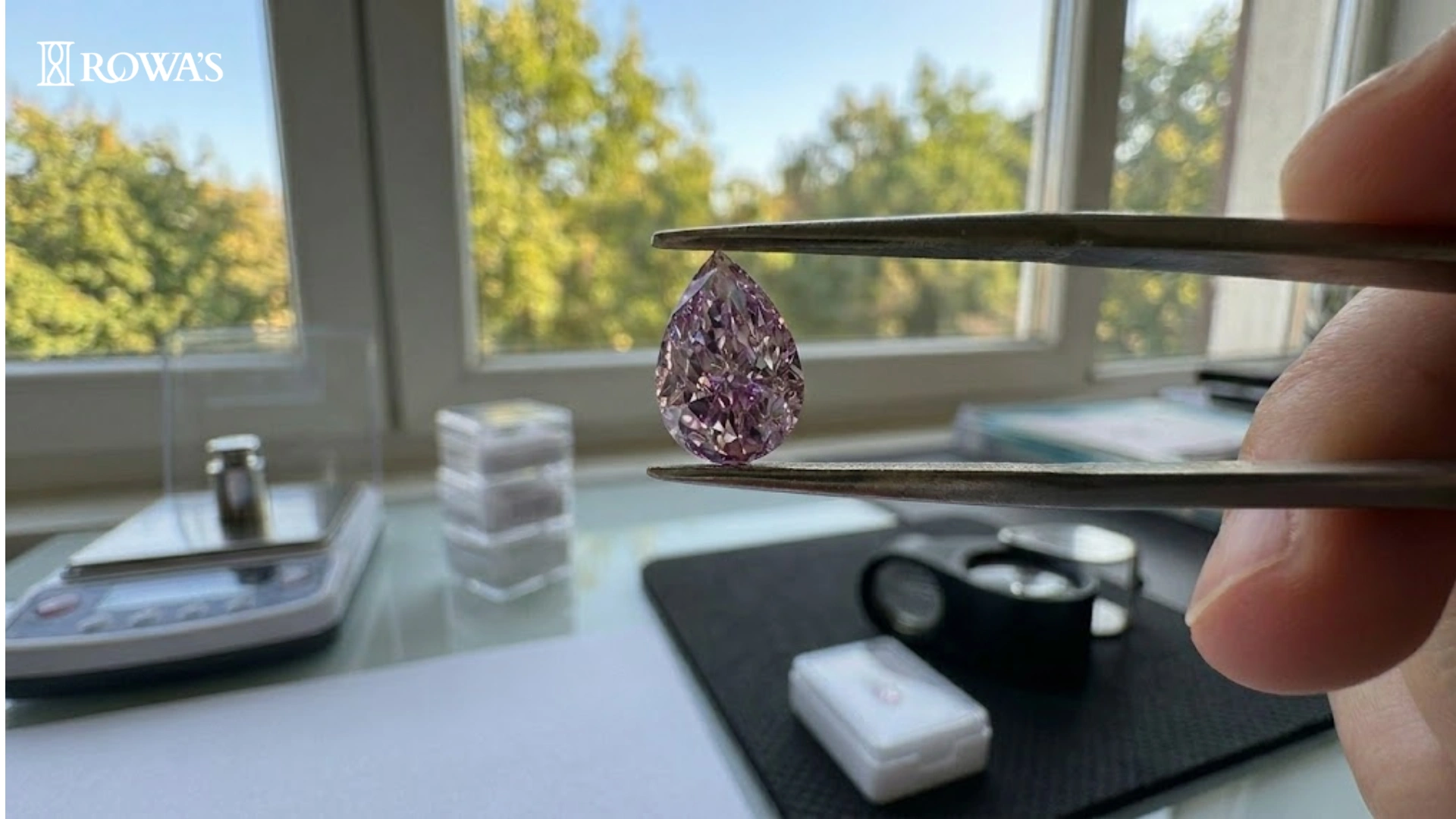
The honest answer, more so than almost any other gemstone, yes.
Natural pink diamonds have shown consistent long-term appreciation that is hard to argue with. The Australian Pink Diamond Index tracked Argyle-certified stones appreciating over 400% in the decade before the mine’s closure. Since 2020, the trend has only continued upward.
The economics are simple: supply is fixed and shrinking. Demand particularly from collectors in China, Hong Kong, and the Middle East keeps growing. That combination points in one direction.
A few honest caveats though:
- They are not liquid. Selling takes time, the right auction house, and the right buyer.
- Lower-intensity stones don’t appreciate at the same rate as Fancy Vivid pieces.
- Certification is everything. Always buy GIA-certified, and look for Argyle provenance documentation on investment-grade stones.
Can Lab-Grown Pink Diamonds Replace Them?
For jewelry absolutely. Lab-grown pink diamonds are real, beautiful, and a fraction of the cost. No debate there.
For rarity and investment value no. The entire worth of a natural pink diamond is tied to its story. Billions of years underground. A geological accident so rare it barely happens. A mine that will never reopen. A supply that gets smaller every year.
You can grow a chemically identical pink crystal in a lab in a few weeks. What you cannot grow is that story. And for collectors, that story is the whole point.
The Bottom Line
Natural pink diamonds are not rare because of marketing or manufactured scarcity. They’re rare because the universe almost never makes them.
Every natural pink diamond is a one-in-a-billion geological accident pure carbon, bent and stressed in exactly the right way, in exactly the right place, over billions of years. The mine that reliably gave us most of them is gone. The ones that exist today are genuinely, permanently irreplaceable.
That’s not a sales pitch. It’s just physics, geology, and time doing something they’ve only done a handful of times in Earth’s entire history.